The rapid adoption of electric vehicles is changing more than the way people travel in the UAE. It is also transforming the electrical infrastructure required to power homes, commercial buildings, parking facilities, fleet depots, shopping centres, hotels, and large-scale developments.
Dubai is at the forefront of this transition. By the end of 2025, the emirate had recorded 47,944 electric vehicles, while its EV charging network had expanded to more than 1,860 charging points by January 2026. DEWA has also continued expanding its Green Charger network through ultra-fast, fast, public, and wall-box charging solutions.
As charging infrastructure becomes more widespread, simply installing EV chargers is no longer enough. Every charging point represents an additional electrical load that must be safely distributed, controlled, protected, and managed.
This is where advanced switchgear solutions become increasingly important.
Why EV Charging Creates New Electrical Demands
EV chargers can place substantial and sustained loads on an electrical distribution system. A single AC wall-box charger may have a relatively manageable demand, but multiple chargers operating simultaneously can significantly increase the load on a building’s electrical infrastructure.
The challenge becomes even greater with fast and ultra-fast DC charging.
For example, DEWA’s current charger specifications include 50 kW DC fast charging and 150 kW DC ultra-fast charging solutions. When several high-capacity chargers operate simultaneously, the resulting demand can affect transformers, feeders, distribution boards, cables, protection systems, and the overall power distribution architecture.
For electrical designers and facility owners, this creates several important requirements:
- Higher available electrical capacity
- Reliable load distribution
- Accurate circuit protection
- Short-circuit and overload protection
- Improved power monitoring
- Selective coordination between protective devices
- Space for future charger expansion
- Safe isolation and maintenance
- Integration with building energy management systems
Consequently, EV infrastructure is increasing the demand for intelligently designed LV switchgear and electrical distribution systems.
The Role of Switchgear in EV Charging Infrastructure
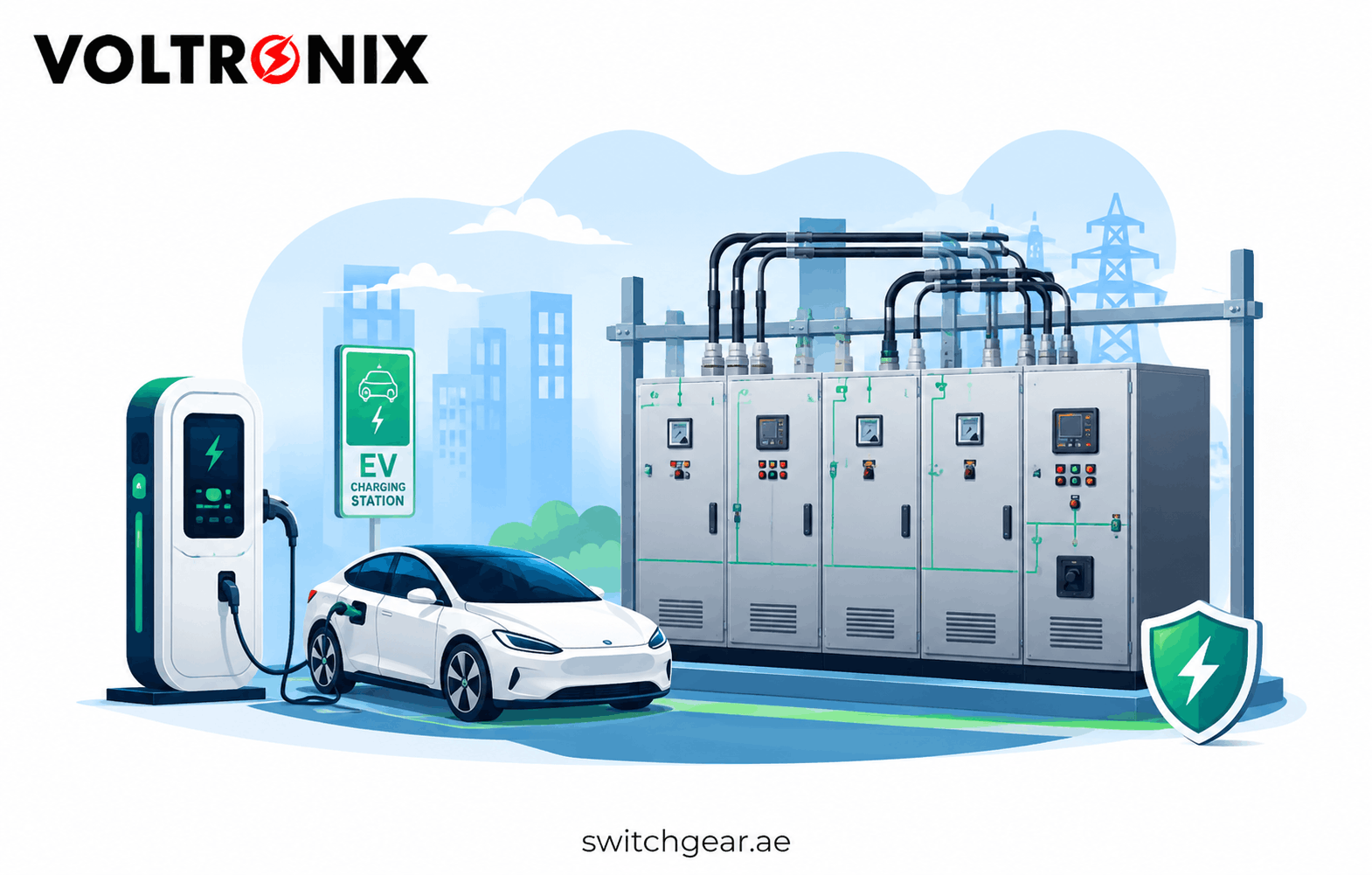
Switchgear provides the control and protection layer between the electrical supply and EV charging equipment.
A properly engineered switchgear system can help distribute power to multiple charging points while protecting the installation against electrical faults and abnormal operating conditions.
Depending on the project, the electrical architecture may include:
- Main LV switchboards
- Sub-main distribution boards
- Motorised or automatic circuit breakers
- MCCBs and ACBs
- Protection relays
- Metering systems
- Surge protection devices
- Busbar systems
- Energy monitoring equipment
- Automatic transfer and switching arrangements
- Communication and remote monitoring interfaces
The exact configuration depends on the site’s electrical capacity, charger type, number of charging points, charging profile, available transformer capacity, and future expansion requirements.
1. Managing High and Variable Electrical Loads
One of the biggest challenges associated with EV charging is that electrical demand is not necessarily constant.
A commercial parking facility, for example, may have dozens of vehicles charging during working hours. A residential development may experience a significant increase in charging demand during evening hours. A fleet facility may have multiple vehicles requiring rapid charging within a limited operating window.
Advanced switchgear can form part of an electrical distribution strategy that accommodates these changing loads.
Modern systems can incorporate metering, monitoring, communication, and automation capabilities that allow facility operators to understand how power is being consumed and identify potential capacity constraints.
This becomes particularly valuable when EV charging is added to an existing building rather than incorporated into a new electrical design.
2. Protecting Electrical Equipment and EV Chargers
EV charging infrastructure requires appropriate electrical protection because faults can affect not only the charger but also upstream electrical equipment.
Switchgear and associated protection devices help isolate faulty circuits and reduce the risk of damage spreading through the electrical distribution system.
Protection requirements can include:
- Overcurrent protection
- Short-circuit protection
- Earth-fault protection
- Residual-current protection where applicable
- Surge protection
- Under-voltage and over-voltage protection
- Appropriate isolation arrangements
The protection strategy must be coordinated with the charger manufacturer’s requirements and the wider electrical system.
This is especially important for high-power charging installations where a fault can involve significantly higher available fault energy.
3. Supporting DEWA-Compliant EV Infrastructure
Dubai’s EV charging market is developing within an increasingly defined regulatory framework.
DEWA’s EV Charging Technical Regulations state that EV charging equipment and installations in Dubai are required to comply with applicable technical standards and regulations. The technical references include IEC 61439 for low-voltage switchgear and controlgear assemblies and IEC 61851 for electric vehicle conductive charging systems, alongside other relevant requirements.
DEWA also operates a regulatory and licensing framework for EV charging infrastructure and independent charge point operators in Dubai. Public charging infrastructure operated by independent charge point operators is subject to DEWA licensing requirements.
For developers, consultants, contractors, and facility owners, this means EV charging infrastructure should be considered as part of the complete electrical design rather than treated as an isolated charger installation.
4. Preparing Electrical Systems for Future Expansion
One of the most common mistakes in EV infrastructure planning is designing only for today’s charging requirements.
EV adoption is continuing to increase, and charging requirements can change as buildings add more electric vehicles, fleet operators transition to electric vehicles, and charging technologies become faster.
A facility that initially requires 10 charging points may eventually require 30 or more.
Advanced switchgear can therefore be designed with future capacity and expansion in mind.
This may involve:
- Additional outgoing feeders
- Spare breaker positions
- Expandable busbar arrangements
- Increased switchboard capacity
- Intelligent metering
- Communication capabilities
- Modular construction
- Space for future protection and control equipment
Planning for expansion during the initial electrical design can reduce the complexity and cost of future modifications.
5. Intelligent Monitoring for EV Charging Facilities
Modern switchgear is increasingly becoming more than a collection of circuit breakers.
Intelligent switchboards can incorporate digital meters, sensors, communication interfaces, and monitoring systems that provide visibility into electrical performance.
For EV charging infrastructure, this can help operators monitor:
- Total electrical demand
- Individual feeder loading
- Energy consumption
- Voltage
- Current
- Power factor
- Power quality parameters
- Circuit status
- Fault conditions
This information can support better operational decisions and help facility teams identify abnormal conditions before they develop into major electrical problems.
For large commercial developments in Dubai, integrating switchgear monitoring with building management or energy management systems can also provide a more complete view of the property’s electrical consumption.
6. EV Charging and Power Quality Considerations
High concentrations of electronic charging equipment introduce additional power-quality considerations that electrical engineers need to evaluate during project design.
Depending on the charger technology and installation, engineers may need to assess:
- Harmonic distortion
- Voltage fluctuations
- Power factor
- Load imbalance
- Transient conditions
- Network capacity
DEWA’s EV Charging Technical Regulations reference several IEC standards addressing electrical installations, electromagnetic compatibility, harmonics, and low-voltage switchgear assemblies.
This highlights why EV charging infrastructure should be designed as part of the overall electrical system rather than simply connected to an available distribution board.
7. Why Existing Buildings May Need Switchgear Upgrades
Adding EV chargers to an existing property can present a different challenge from designing a new development.
An existing building may already have:
- Limited spare capacity
- Older switchboards
- Fully occupied feeder ways
- Outdated protection devices
- Limited monitoring capabilities
- Restricted electrical room space
- Existing voltage or power-quality concerns
Before adding multiple chargers, an electrical assessment should determine whether the existing infrastructure can safely accommodate the additional demand.
In some cases, the appropriate solution may involve upgrading the main LV switchboard, adding a dedicated EV distribution board, modifying protection settings, increasing transformer capacity, or introducing a dedicated feeder arrangement.
The correct solution should always be based on an engineering assessment rather than simply selecting a larger breaker.
8. Dedicated EV Distribution Boards for Large Installations
For larger charging facilities, a dedicated EV distribution system can provide better control and flexibility.
Instead of connecting multiple chargers directly to general-purpose building distribution boards, engineers can create dedicated feeders and distribution equipment specifically for EV charging.
This approach can simplify:
- Load management
- Maintenance
- Circuit identification
- Protection coordination
- Energy monitoring
- Future expansion
- Fault isolation
Dedicated EV switchboards can also help separate charging loads from critical building loads, which can be particularly valuable in facilities where electrical continuity is important.
9. Why Load Management is Becoming Essential
Not every EV charger needs to operate at maximum capacity simultaneously.
Smart charging and load-management strategies can distribute available electrical capacity between chargers according to demand and site limitations.
For example, a facility with limited electrical capacity could dynamically allocate available power across multiple charging points instead of allowing every charger to operate at maximum demand.
This can reduce unnecessary infrastructure loading and make better use of existing electrical capacity.
Switchgear equipped with suitable monitoring, communication, and control capabilities can support these intelligent energy-management strategies.
EV Charging is Changing Switchgear Design in Dubai
The growth of EV infrastructure is creating a shift in the way electrical distribution systems are planned.
Traditional switchgear design primarily focused on supplying predictable building loads. EV charging introduces additional loads that can be high-powered, simultaneous, variable, digitally controlled, and likely to increase over time.
As a result, electrical infrastructure for EV-ready buildings increasingly needs to consider:
Capacity + Protection + Monitoring + Automation + Scalability
This is particularly relevant to Dubai, where EV adoption, charging infrastructure, and regulatory requirements are developing together.
DEWA’s latest framework specifically addresses the development and operation of EV charging infrastructure and is designed to accommodate both current requirements and future growth.
Choosing the Right Switchgear for EV Charging Projects
Selecting switchgear for an EV charging installation should not be based solely on the charger’s rated power.
A professional assessment should consider:
Total Connected Load
Calculate the combined demand of all existing and proposed chargers.
Maximum Demand
Determine realistic simultaneous charging requirements rather than relying only on connected load.
Available Short-Circuit Capacity
Ensure the selected switchgear and protective devices are suitable for the site’s prospective fault level.
Protection Coordination
Coordinate upstream and downstream protective devices to achieve appropriate fault isolation.
Power Quality
Assess harmonics, voltage variations, power factor, and other relevant characteristics.
Environmental Conditions
For outdoor or semi-outdoor installations, enclosure protection and environmental conditions must be carefully considered, particularly given Dubai’s high temperatures, dust, and demanding operating conditions.
Future Expansion
Allow sufficient capacity and physical space for additional chargers and associated equipment.
Monitoring and Communication
Consider intelligent metering and communication capabilities where energy management and remote monitoring are required.
Building the Electrical Infrastructure Behind Dubai’s EV Future
The transition to electric mobility is creating a new class of electrical infrastructure projects across Dubai.
Residential communities, commercial buildings, hotels, retail developments, fleet facilities, parking structures, and mixed-use developments may all require EV charging capabilities. As charging capacity increases, the electrical distribution system supporting these chargers becomes increasingly important.
Advanced switchgear provides the foundation for distributing, protecting, monitoring, and controlling these additional electrical loads.
At Switchgear, we understand that reliable power distribution starts with engineering the right electrical infrastructure for the application. From LV switchgear and electrical panels to protection and distribution solutions, our approach focuses on safety, reliability, performance, and future scalability.
For organisations planning EV charging infrastructure in Dubai or upgrading an existing electrical system to support EV charging, evaluating the switchgear and power-distribution architecture early in the project can help prevent capacity constraints, costly modifications, and avoidable operational issues later.
Planning an EV charging project in Dubai? Consult an experienced switchgear specialist to assess your electrical capacity, protection requirements, and future expansion needs before installation begins.